 VampGuard
Transaction bundles and bundled wallets are different concepts
At the transaction level, a bundle is a way to submit a group of transactions together. Jito documents bundles of up to five transactions that execute sequentially and atomically: if one fails, the bundle does not commit. The mechanism also supports legitimate uses such as arbitrage. Using a bundle does not, by itself, establish malicious intent.
In token research, a bundled-wallet warning is a scanner’s assessment of activity associated with a set of wallets. Do not assume that every scanner proves the same transaction mechanism, identifies the same wallets or establishes who controls them. Read the provider’s definition before interpreting the label.
Why separate wallet addresses can matter
Counting addresses is not the same as counting independent participants. If related wallets hold a meaningful share of supply, a holder list can give an incomplete picture of concentration. The research question is whether the observed distribution and trading activity support the impression of independent demand.
Timing, transfers and funding history can provide context, but a shared transaction pattern is not a verified identity. Investigate the underlying activity before concluding that wallets belong to one person or to the project team.
Why bundle percentages differ between scanners
Providers can use different definitions, observation windows and filtering rules. Axiom’s documentation explicitly describes its own bundle checker and acknowledges that false positives and missed bundles are possible. GMGN also offers bundled-wallet metrics, but that does not make the outputs interchangeable.
Before comparing two percentages, check the token’s full contract address, when each scan ran, what each percentage measures and whether either result is incomplete. A difference between two tools is a prompt to investigate their coverage, not automatic evidence that one is correct.
Reading VampGuard’s Proxima Bundle warning
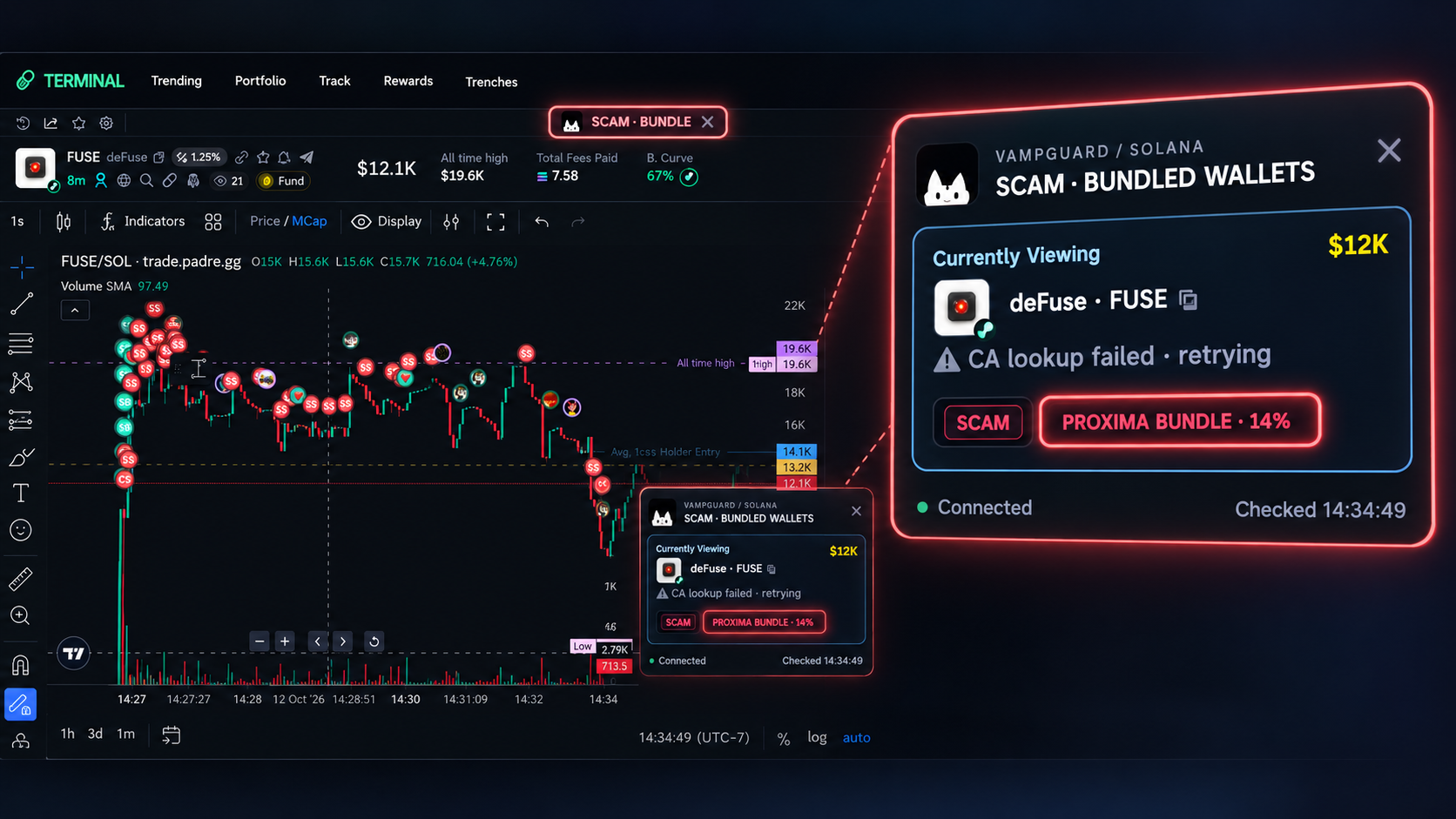
PROXIMA BUNDLE is VampGuard’s label for a specialized bundle-risk assessment. Where a percentage is available, it represents the estimated token supply associated with that signal. It is not the probability of a rug pull, the percentage of wallets that are malicious or confirmation that a particular tool was used.
The annotated example below shows a 14% Proxima Bundle label alongside a separate CA lookup retry message. Those communicate different things: one is the displayed bundle-risk signal; the other says the contract-address lookup was incomplete. A connected status does not mean every check has succeeded. The image documents a past interface state and is not a current assessment of the pictured token.
A practical workflow when a warning appears
First, confirm the contract address so you are researching the intended token. Next, read the warning and its available percentage, then check whether any related checks are pending or unavailable. Record the time of the observation when comparing it with another source.
Then examine available holder distribution, transfers and trading activity alongside the chart. Ask whether the evidence supports a concentration concern, which details remain uncertain and what additional information would change your interpretation. Keep social-address checks separate: a matching post can establish address evidence without establishing token safety.
VampGuard keeps these warnings and competing-launch comparisons beside supported Axiom and Terminal charts. This reduces the need to reconstruct your research across tabs, while leaving the final interpretation with you.
Does a bundle warning mean a token is a scam?
No. An automated label is a reason to investigate, not proof of fraud. The SCAM wording visible in the example is a product warning, not an independently verified finding about that project. A transaction bundle can have legitimate uses, and wallet-risk assessments can be incomplete or mistaken.
Is a token safe if no bundle warning appears?
No. The absence of a warning is limited by the scanner’s coverage and available data. A token can carry other risks, and a scan can change as new information arrives. A pending or unavailable result should never be read as a completed clean assessment.
Sources and further reading
- Jito documentation: transaction bundles and atomic execution
- Axiom FAQs: bundle checker definitions and limitations
- GMGN documentation: bundled-wallet research metrics
- VampGuard: a workflow for researching Solana tokens
Public sources checked October 12, 2026. Provider definitions can change. The Proxima label explanation describes VampGuard’s public interface, not another provider’s detection methodology.